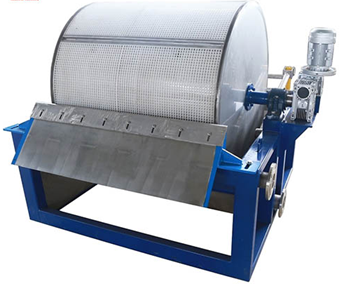
Rotary Drum Thickeners are commonly used in dewatering applications to concentrate or thicken sludge by removing excess water.
They are particularly effective in wastewater treatment plants, where they serve as a pre-dewatering step, increasing the sludge’s solid concentration before further processing or disposal.
How Rotary Drum Thickeners Work
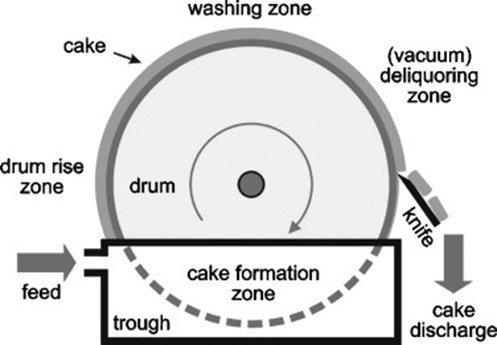
A rotary drum thickener consists of a slowly rotating drum, typically made of perforated metal or mesh, enclosed in a tank. The dewatering process operates as follows:
- Flocculation:
Before entering the drum, the sludge is usually treated with a polymer or coagulant to encourage the formation of larger particles or “flocs.” This flocculation process improves water separation. - Drum Rotation:
The flocculated sludge is fed into the rotating drum. As the drum turns, gravity pulls water through the drum’s perforations or mesh, while the solids are retained inside the drum. - Thickened Sludge Discharge:
The thickened sludge moves gradually through the drum and is discharged at the other end. This process significantly reduces the water content, concentrating the solids in the sludge.
Key Applications
- Wastewater Treatment:
Rotary drum thickeners are extensively used in municipal and industrial wastewater facilities to thicken primary and secondary sludge before it goes to other dewatering or drying processes. - Food Processing:
In food and beverage industries, rotary drum thickeners concentrate organic waste, like fruit pulps and other fibrous materials, making them easier to handle or process further. - Pulp and Paper:
These thickeners are used to concentrate pulp in paper mills, reducing water content before additional dewatering steps.
Advantages
- Low Energy Requirement:
Rotary drum thickeners operate at slow speeds, consuming far less energy than other dewatering methods like centrifuges or belt presses. - Continuous Operation:
They allow for continuous sludge thickening, which is efficient for high-volume applications. - Compact Design:
Rotary drum thickeners require relatively little floor space, making them suitable for facilities with limited space. - Reduced Polymer Usage:
Compared to other dewatering processes, they require less polymer to achieve efficient thickening, saving on chemical costs.
Limitations
- Lower Solids Concentration:
Rotary drum thickeners typically produce a less concentrated sludge than other dewatering equipment, so they are often used as a preliminary thickening step. - Not Suitable for All Sludge Types:
They are most effective with sludges that flocculate easily. Fine or oily sludges may pass through the drum, leading to inefficient thickening. - Maintenance Requirements:
The drum’s mesh or perforations can become clogged over time, especially with fibrous or fine particles, requiring periodic cleaning and maintenance.
Rotary drum thickeners offer an efficient, low-cost solution for preliminary sludge thickening, especially when used as a pre-treatment step in wastewater processing. Their compact size and energy efficiency make them particularly valuable for facilities looking to reduce operating costs while managing large sludge volumes.