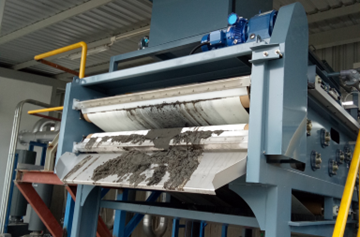
Belt filter presses are widely used in dewatering applications to separate liquids from solids, particularly in industries like wastewater treatment, mining, and food processing.
They use mechanical pressure and gravity to squeeze water out of sludge or slurry, reducing the moisture content of the final product.
How Belt Filter Presses Work
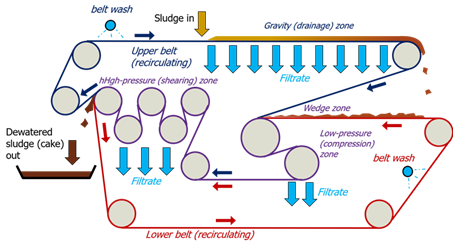
The dewatering process in a belt filter press occurs in multiple stages:
- Initial Gravity Drainage:
The sludge or slurry is fed onto a moving, porous filter belt. As it travels along the belt, gravity allows free water to drain through the filter fabric. - Low-Pressure Zone:
The material then moves into a low-pressure zone where it is sandwiched between two belts. Rollers apply light pressure, squeezing out more water. - High-Pressure Zone:
Finally, the sludge passes through a series of progressively tighter rollers, creating high pressure to maximize water extraction. The thickened, partially dry solid material is discharged at the end of the process.
Key Applications
- Wastewater Treatment:
Belt filter presses are extensively used in municipal and industrial wastewater treatment facilities to dewater sewage sludge. They reduce sludge volume, making it more economical to transport and dispose of. - Mining:
In mining operations, belt filter presses remove excess water from mineral slurries, producing a solid concentrate that is easier to handle, transport, or process further. - Food Processing:
They are used in food industries to separate water from organic waste materials, such as fruit pulps and vegetable residues, enabling easier disposal or reuse.
Advantages
- Continuous Operation:
Belt filter presses run continuously, making them ideal for high-throughput dewatering applications. - Energy Efficient:
They generally consume less energy than other dewatering equipment, as they rely largely on mechanical pressure rather than high-speed rotation or vacuum systems. - Cost-Effective:
Belt filter presses have relatively low operating and maintenance costs compared to other dewatering technologies. - Versatile:
Effective across a wide range of sludge and slurry consistencies, from low to medium solids concentration.
Limitations
- Lower Dryness:
Compared to other methods like centrifuges or filter presses, belt filter presses may leave a slightly higher moisture content in the final solids. - Require Polymer Additives:
To optimize dewatering performance, polymer flocculants are often added to sludge, which can increase operating costs. - Space Requirements:
Belt filter presses can take up considerable floor space, especially when sized for high-capacity applications.
Belt filter presses are highly valued for their simplicity, energy efficiency, and ability to handle large volumes, making them a popular choice in industries that prioritize continuous, cost-effective dewatering.