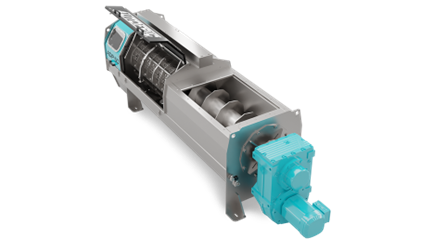
Screw presses are mechanical dewatering machines used to extract water from solid materials by applying continuous pressure using a screw mechanism.
These machines are particularly effective in industries where organic materials and sludge need to be dewatered, such as wastewater treatment, food processing, and paper production.
How Screw Presses Work
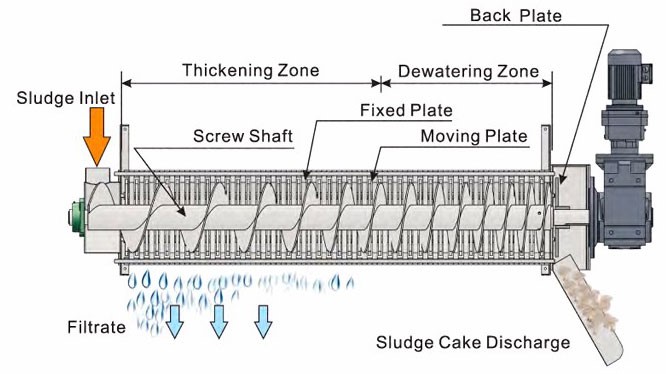
A screw press operates with a rotating screw inside a cylindrical screen or chamber:
- Feeding Zone:
The material, usually sludge or slurry, is fed into the inlet of the screw press. The screw slowly pushes it forward as it rotates. - Compression Zone:
As the material advances, the screw narrows within the screen or chamber, applying increased pressure on the material and forcing water out through the screen openings. - Discharge:
The compressed, dewatered solid exits through the end of the screw chamber, while the liquid (filtrate) is collected separately.
Key Applications
- Wastewater Treatment:
Screw presses are used to dewater sludge in both municipal and industrial wastewater treatment plants, resulting in drier, more compact sludge for disposal. - Food and Beverage Processing:
They are used to extract juice from fruits and vegetables or to separate water from food waste, making disposal or further processing easier. - Paper and Pulp Industry:
Screw presses dewater pulp and paper waste, reducing moisture and improving the efficiency of downstream processing.
Advantages
- Compact and Energy Efficient:
Screw presses are known for their low power consumption and compact design, which makes them suitable for installations with limited space and where energy efficiency is prioritized. - Continuous Operation:
Screw presses operate continuously, allowing for high throughput with minimal interruption, ideal for large-scale operations. - Low Maintenance: With fewer moving parts compared to other dewatering machines, screw presses generally require less maintenance and have lower wear rates.
- Versatile for Thick Sludge:
They can handle a wide range of material consistencies, including very thick sludge and fibrous materials, making them flexible across various applications.
Limitations
- Moderate Dewatering Efficiency:
Screw presses may not achieve as high a level of dryness as other methods, such as centrifuges or filter presses, especially for fine particles. - Requires Consistent Feed Material:
For optimal performance, the material’s consistency should be relatively stable; fluctuations in thickness or composition can impact dewatering efficiency. - Limited for Very Fine Solids:
Screw presses are not as effective with fine particles that can pass through the screen, which may require additional filtering steps.
Overall, screw presses offer a reliable, energy-efficient option for continuous dewatering, especially suited for applications that involve fibrous or thick sludge, where high-throughput and low maintenance are critical.